
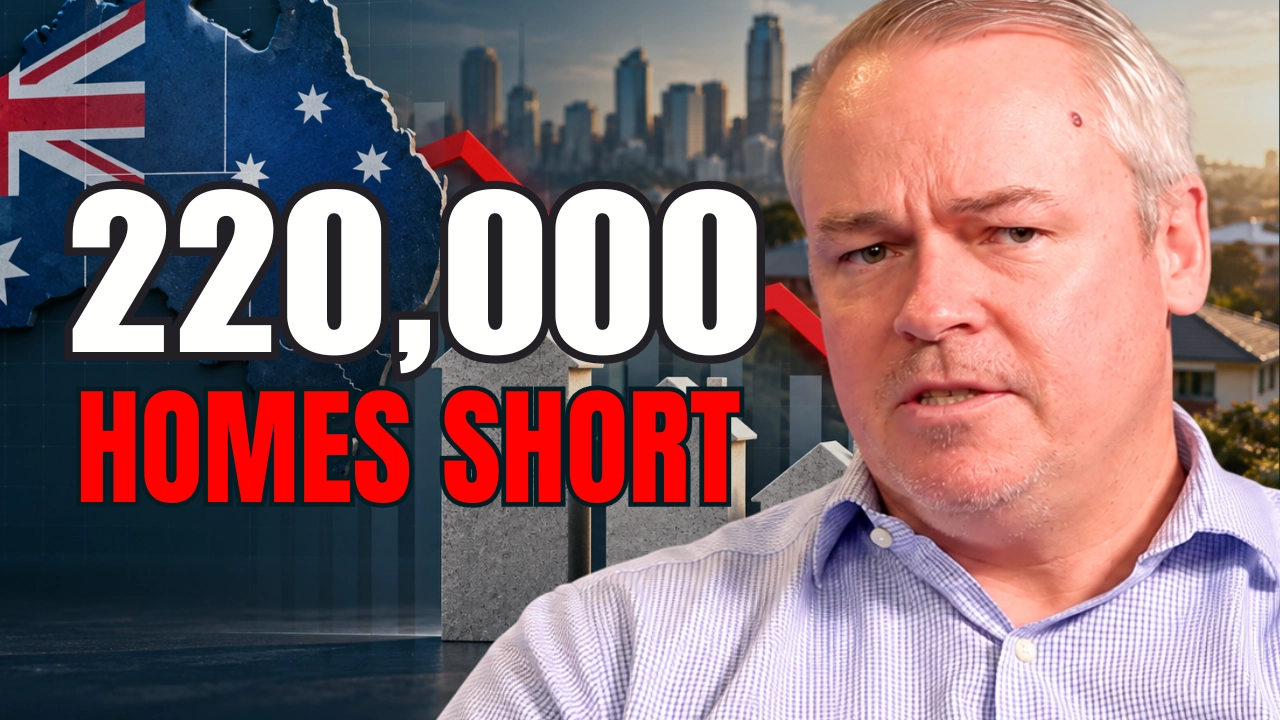
Australia has set itself a target of building 1.2 million new homes over five years, from July 2024 to June 2029.
That means roughly:
- 240,000 homes a year
- 60,000 every quarter
- around 4,600 every week
The problem is simple.
We aren’t building them quickly enough.
After seven quarters of the Housing Accord period, around 308,000 homes have been completed. At an even pace, we would need to be at about 420,000.
There is some encouraging news. Building approvals and commencements have improved.
But the National Housing Supply and Affordability Council now expects Australia to reach the 1.2 million target in the December quarter of 2030 — around 18 months late.
And housing demand doesn’t simply stop while we catch up.
We’re trying to build everything at once
Housing isn’t the only thing Australia needs to build.
At the same time, we have roads, rail, hospitals, energy projects, public housing and other major infrastructure underway.
Infrastructure Australia’s five-year Major Public Infrastructure Pipeline alone is worth $242 billion.
It also estimated that public infrastructure was already short around 141,000 workers, with the shortage potentially exceeding 300,000 by 2027.
To be fair, the evidence doesn’t prove infrastructure projects are directly taking huge numbers of workers from residential construction.
But we still have one construction economy.
There are only so many:
- tradespeople and labourers
- engineers and project managers
- plant and equipment
- construction materials
You can’t announce every project independently and assume unlimited resources will magically appear.
At some stage, somebody needs to do the maths.
What are we trying to build, what resources will it take, and do we actually have them?
Then there’s the developer
Another part of the equation is private development.
There is a tired misconception that every property developer is making money hand over fist.
Some do very well. Good luck to them — hopefully they come back and build another project.
But development isn’t automatically a licence to print money.
A project has to absorb:
- design and consultant costs
- council and infrastructure contributions
- construction costs
- finance and holding costs
- acquisition and selling costs
- GST on new residential property
- development risk
Then the buyer doesn’t particularly care what those costs were.
The market decides what the finished property is worth.
Eventually the developer asks one simple question:
Does the project stack up?
If it doesn’t make dollars, it doesn’t make sense.
A sensible developer doesn’t build an uneconomic project simply because Australia needs more housing. They look elsewhere.
That’s a problem if we genuinely want more homes built.
Could GST be one setting worth reconsidering?
There isn’t one magic solution to Australia’s housing shortage.
But we should look harder at the economics of producing new housing.
One option worth considering is a temporary reduction in GST payable under the margin scheme for qualifying new residential developments.
Under the margin scheme, GST is broadly calculated as one-eleventh of the applicable margin.
What if that burden was temporarily reduced for genuine new residential construction — perhaps for five years while we’re trying to catch up?
Yes, the Commonwealth would collect less GST.
There is a cost.
But that’s the policy decision.
If housing supply is genuinely a national priority, it is reasonable to ask whether collecting the maximum GST from new residential development is working against that objective.
Would that make houses cheaper?
Not necessarily.
Reducing the developer’s GST doesn’t mean the saving automatically gets passed to the purchaser.
The market still determines what someone will pay.
What it can do is improve the feasibility of the development.
A marginal project today might suddenly stack up.
That can mean:
- the developer proceeds
- finance becomes easier to justify
- construction starts
- more homes reach the market
The objective isn’t making developers richer for the sake of it.
It’s getting commercially viable housing projects built.
We need to look at the whole system
GST isn’t going to solve the problem by itself.
We need to look at:
- planning and approval times
- construction productivity
- workforce capacity
- infrastructure sequencing
- development contributions
- construction and finance costs
- taxation
- whether private development remains commercially viable
There are positive signs. Approvals and commencements have increased, and there were around 244,000 dwellings under construction in the March 2026 quarter.
But the overall target continues to slip.
Announcing homes is easy. Building them is the hard bit.
Australia still needs the housing.
If today’s housing requirement takes another year or two to deliver, new demand doesn’t politely wait for us to catch up.
The target keeps moving.
We need to look at what is stopping good projects from proceeding, what is constraining construction capacity, and whether some policy settings need to change.
Maybe GST is part of that discussion.
Maybe there are better ideas.
But doing essentially the same thing and checking the numbers again in another 12 months isn’t much of a strategy.
What setting would you change first if the goal was simply to get more homes built?
Disclaimer: This article provides general information only and does not take into account your personal circumstances. It is not financial or tax advice. You should seek independent advice from a qualified professional before making decisions about tax, legal or financial planning matters, along with loan structures or entity structure.