
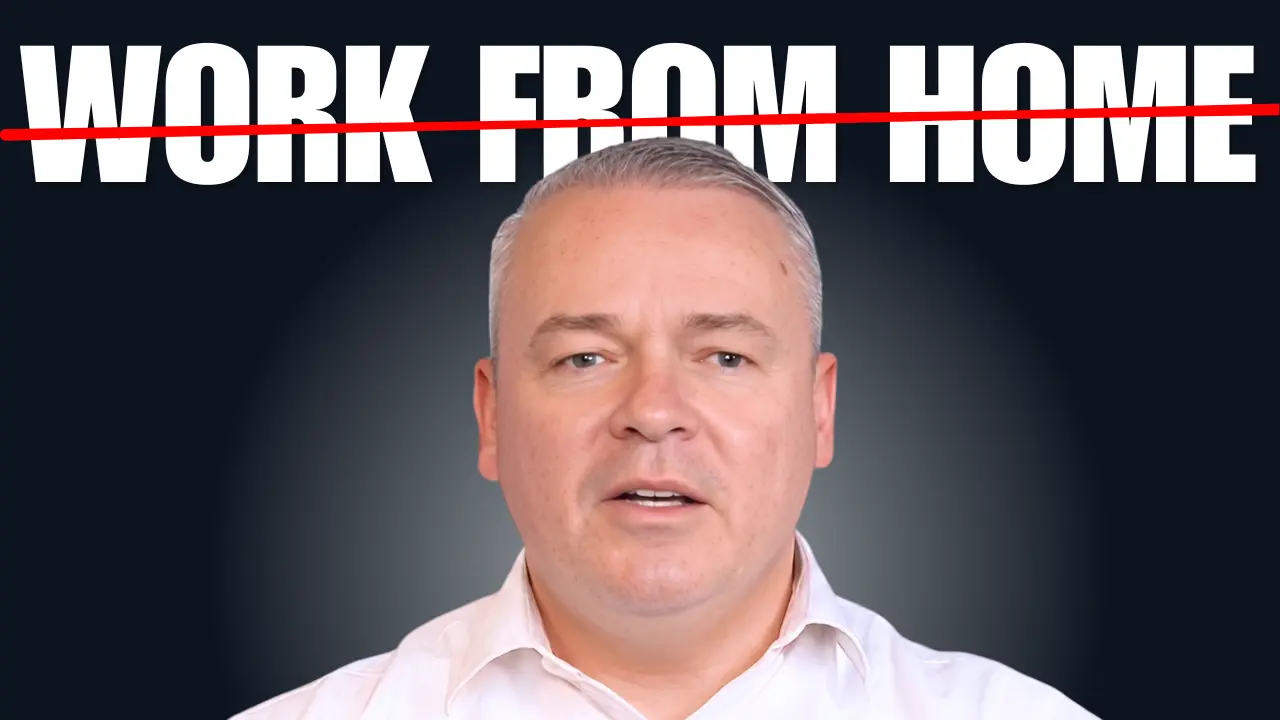
There is a very neat story around working from home.
It usually goes something like this:
- more flexibility
- lower transport costs
- more peace and quiet
- more trust from your employer
- a better lifestyle
And to be fair, some of that is true.
But I think a lot of younger workers have been sold the benefits without enough discussion about the trade-offs.
My view is simple: working from home does not suit everyone equally.
If you are early in your career, particularly within roughly the first 10 years of working life, my advice would generally be to get into the office as often as you reasonably can.
That is not because I am old-fashioned.
It is because the real value of the early years of your career is not convenience.
It is exposure, learning and seeing how experienced people think.
The equation changes with career stage
I am not anti-working from home.
For experienced workers, there can be real benefits:
- fewer interruptions
- more quiet time
- less travel
- better focus
- more flexibility around family and life
A senior person can often work remotely and still perform well because they already have judgement, context and experience in the bank.
A junior person is still building those things.
Judgement does not come just from completing tasks on a laptop.
It comes from being around the work.
It comes from overhearing the right conversation, watching a senior person handle something messy, and asking, “Why did you go that way?”
That is much harder to pick up from home.
Some of the best learning is not planned
When I was young and on a steep learning curve, some of the best lessons were not formal training sessions.
They happened because something came up.
A client called with an issue.
A meeting took a turn.
A problem landed on someone’s desk.
Something commercially interesting appeared out of nowhere.
My father was my boss at the time, and he would drag me in and say, in effect, “Come in here. There is something worth seeing.”
That sort of learning was gold because it was real.
You got to see:
- what the senior person noticed
- what they ignored
- what questions they asked
- how they stayed calm
- how they sorted noise from substance
- how they reached a conclusion
If you are not physically there, there is every chance you miss that moment.
Not because anyone is against you.
Business simply moves quickly.
People do not stop every five minutes and think, “Let me dial in the junior staff member from home.”
That is not criticism. It is reality.
What junior staff may be missing
The impact may not be obvious in year one or two.
The difference may show up five or ten years later, when today’s junior staff become tomorrow’s seniors and managers.
Someone who spent their early years close to the work is likely to have built a stronger feel for:
- commercial judgement
- client interaction
- problem-solving under pressure
- how senior people think
- how to ask better questions
- how to make decisions with incomplete information
Someone who has mainly learned through isolated task completion can still be technically capable, but may take longer to build broader commercial judgement.
That judgement is often the difference between someone who completes work and someone who can lead it.
Chase the thought process, not just the task
One of the best learning tools for me was not simply seeing what a senior person changed in a file.
It was understanding why they changed it.
Why did that fact matter?
Why did they reach that conclusion?
Why did they ask that question?
Why did the meeting suddenly move in another direction?
That explanation gives a junior person a framework.
It helps them:
- attack problems better
- analyse more clearly
- think commercially
- make sense of messy situations
- apply the lesson elsewhere
Younger staff should not just chase tasks.
They should chase thought process.
SME owners should capture this knowledge
Businesses can also be smarter about how they mentor staff.
If you are an SME owner or senior manager, do not mentor people in the moment and then let that knowledge disappear.
There is often an enormous amount of practical experience sitting in the heads of senior staff.
Too often it walks out the door each evening, or eventually leaves the business entirely.
Where appropriate, consider:
- recording key mentoring sessions
- capturing the senior person’s thought process
- summarising key lessons
- building a training bank for current staff
- using that knowledge for future onboarding
It does not need to become an over-produced training program.
Done properly, one useful conversation can become a long-term asset for the whole team.
My practical advice to junior staff
If you are early in your career, here is the simple version.
1. Get into the office as much as you can
Be there.
Be available.
Be in the room when something interesting crops up.
2. Be strategic about your office days
If you cannot be there every day, identify the senior people who are best able and most willing to invest in you.
Line your office days up with theirs.
3. Let people know you want exposure
Tell senior staff you are keen to sit in on interesting calls, meetings and problem-solving sessions.
They are not mind readers.
4. Ask “why”
Do not just ask what was done.
Ask:
- Why did you reach that conclusion?
- Why did you ask that question?
- Why did the meeting go that way?
- Why did this issue matter more than the others?
That is how judgement develops.
5. Take advantage of the opportunity
There are often fewer junior staff physically in the office competing for senior time and attention.
That creates an opportunity.
Less competition can mean more access for the person who shows up.
This is not anti-working from home
This is not a spray against working from home.
It is simply a pushback against the idea that it suits everybody equally, regardless of age, role or career stage.
For some people, it works extremely well.
For others, particularly those still building experience, judgement and commercial instinct, the downside may be bigger than they realise.
That does not mean never work from home.
It means being honest about what you may be giving up in exchange for the convenience.
Final thought
If you are early in your career, do not underestimate the value of proximity.
Being in the office will not magically make you better.
But it puts you in the path of learning, mentoring and spontaneous opportunity.
Over time, that can matter far more than a quieter spare bedroom and a cheaper train fare.
Show up.
Stay curious.
Watch how good people think.
Ask why.
Your future self will very likely thank you for it.
If you have a view on this, particularly from the employer or junior staff side, I would be interested to hear it.
Disclaimer: This article provides general information only and does not take into account your personal circumstances. It is not financial or tax advice. You should seek independent advice from a qualified professional before making decisions about tax, legal or financial planning matters, along with loan structures or entity structure.